<!DOCTYPE html>
<html lang="en">
<head>
<meta charset="UTF-8">
<meta name="viewport" content="width=device-width, initial-scale=1.0">
<title><a href="/article/the-pulse-of-youth-how-the-jantar-mantar-protests-are-redefining-environmental-activism-in-india" title="The Pulse of Youth: How the Jantar Mantar Protests Are Redefining Environmental Activism in India" class="internal-link">Jantar Mantar</a>: The Beating Heart of Indian Dissent — A History of Protests, Power, <a href="/article/why-jharkhand-students-are-protesting-a-deep-dive-into-education-rights-government-response-and-the-" title="Why Jharkhand Students Are Protesting: A Deep Dive into Education Rights, Government Response, and the Role of Public Figures like Rahul Gandhi" class="internal-link">and the</a> Shrinking Space for Civil Society</title>
<meta name="description" content="Explore the history and significance of Jantar Mantar as India's symbolic epicenter of dissent, from its origins as an astronomical observatory to its role in modern protests.">
<meta name="keywords" content="Jantar Mantar protest history, right to protest India Article 19, Supreme Court protest guidelines India, Mazdoor Kisan Shakti Sangathan judgment, NGT ban Jantar Mantar, civil society space shrinking India, CJP protest Delhi, designated protest sites Delhi, history of dissent India, Lutyens Delhi protest culture">
<style>
.container { max-width: 1200px; margin: 0 auto; padding: 20px; }
.image-suggestion { display: block; margin: 20px auto; }
</style>
</head>
<body>
<div class="container">
<h1>Jantar Mantar: The Beating Heart of Indian Dissent — A History of Protests, Power, and the Shrinking Space for Civil Society</h1>
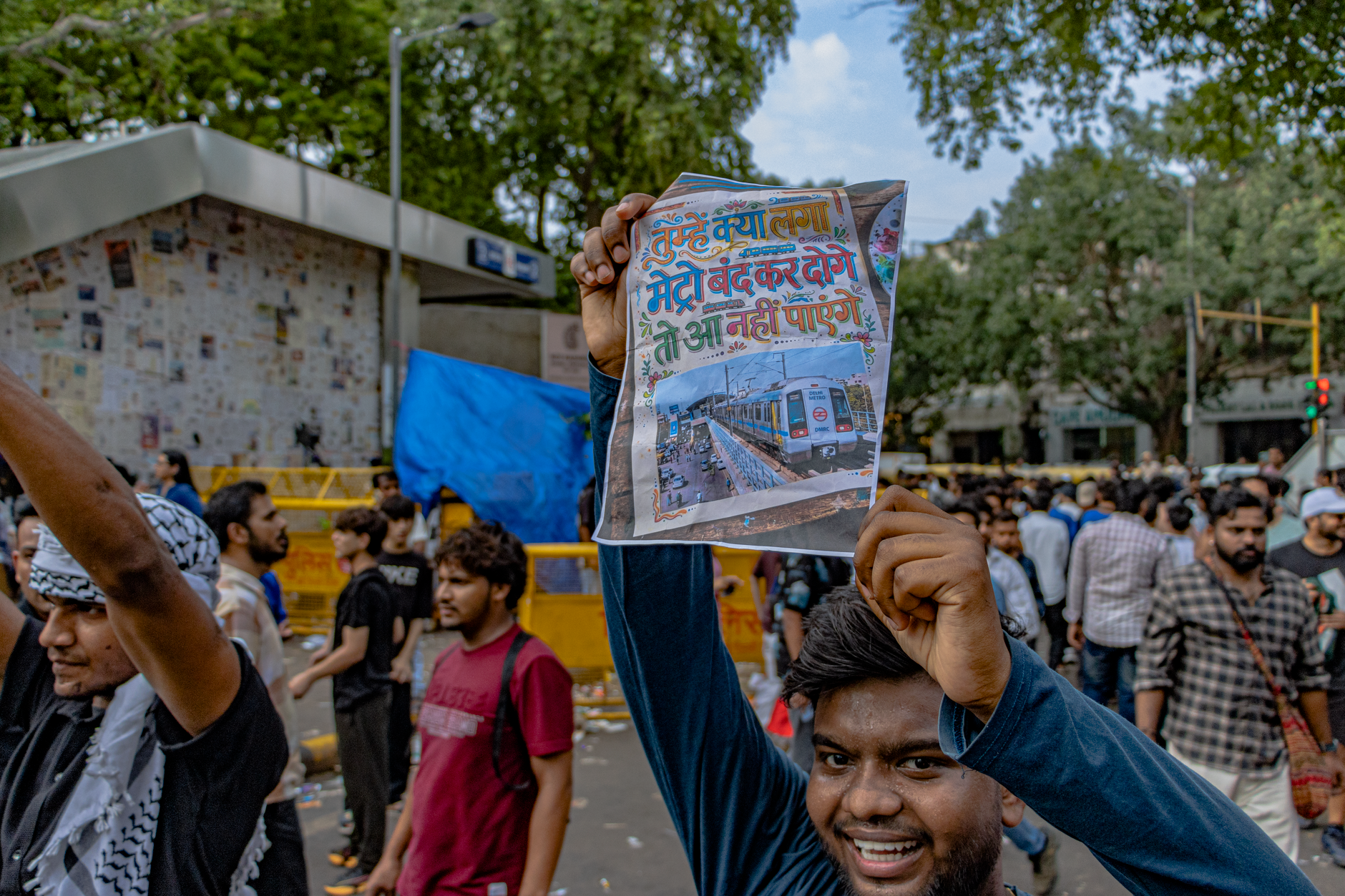
<p><b>Jantar Mantar</b> — a name that resonates with celestial precision — has become the metaphorical fulcrum of India’s democratic resistance. On a sweltering April morning in 2026, protesters led by <b>Dipika Singh</b> and a coalition of activists physically <b>reclaimed</b> the site after authorities dismantled tents and barricades erected during a month-long <b>CJP protest</b>. The clash, though seemingly routine, marked another chapter in a centuries-old struggle between state control and citizen expression. What began as an astronomical marvel — a 1724 observatory built by Maharaja Jai Singh II — has transformed into India’s most iconic <b>protest capital</b>.</p>
<p>This article traces its evolution, the legal battles that threaten its existence, and its enduring role as a symbol of dissent.</p>
<h2>From Observatory to Arena: The Accidental History of a Protest Capital</h2>
<p>Before its current identity as India’s <b>protest epicenter</b>, Jantar Mantar was a <b>scientific sanctuary</b>. Constructed in 1724 by Maharaja Jai Singh II of Jaipur, the site housed five monumental <b>yantras</b> — astronomical instruments designed to measure time, predict eclipses, and map celestial bodies. The <b>Samrat Yantra</b>, a colossal sundial, remains its crown jewel, its shadow still marking the passage of time. But for 150 years, the structure lay dormant, its purpose forgotten.</p>
<p>The revival of Jantar Mantar as a protest site began in the 1990s, catalyzed by the <b>1993 Parliament attack</b>. Authorities banned public demonstrations on India Gate lawns and the adjacent Boat Club grounds, forcing activists to seek alternatives. Jantar Mantar, with its <b>central Delhi location</b> and proximity to Parliament, emerged as the default venue. Its <b>iron railings</b>, once inscribed with equations, became canvases for slogans.</p>
<p>By the 2000s, it had solidified its role as the <b>de facto “Speakers’ Corner”</b> of New Delhi — a space where dissent could be both seen and heard.</p>
<h3>Key Shifts in Jantar Mantar’s Identity</h3>
<ul>
<li><b>1993:</b> India Gate protests banned; Jantar Mantar becomes default site.</li>
<li><b>2000s:</b> Shift from sporadic protests to institutionalized dissent.</li>
<li><b>2011:</b> Anna Hazare’s <b>India Against Corruption</b> movement transforms it into a national stage.</li>
</ul>
Advertisement
Loading partner content...
<h2>The Hall of Fame: Iconic Movements That Defined the Site</h2>
<p>Jantar Mantar’s history is etched in the <b>tents</b> and <b>mikes</b> of transformative movements. Each protest added a new layer to its legacy, blending raw emotion with strategic symbolism.</p>
<h3>Anna Hazare’s 2011 India Against Corruption Fast</h3>
<p>Led by anti-corruption crusader Anna Hazare, the 2011 <b>Jantar Mantar dharna</b> drew over a million participants. The movement’s <b>fast unto death</b> tactic, paired with round-the-clock vigils, forced the government to form the <b>Lokpal Bill</b>. The site buzzed with <b>langar</b> (community kitchens) and <b>poster-filled barricades</b>, creating a visual grammar of resistance.</p>
<h3>The 2012 Nirbhaya Protests: Spontaneous Fury</h3>
<p>Following the brutal <b>Nirbhaya gang-rape case</b>, thousands gathered at Jantar Mantar in 2012, chanting <b>“Justice for Nirbhaya”</b>. The protests were <b>leaderless</b> and <b>spontaneous</b>, reflecting the public’s unfiltered rage. For days, protesters occupied the site, their demands for <b>gender justice</b> echoing globally.</p>
<h3>Farmers’ Protest (2020-21): The Year-Long Siege</h3>
<p>While the <b>farmers’ protest</b> centered on Punjab’s borders, Jantar Mantar hosted daily <b>Kisan Sansad</b> (farmers’ parliaments). Activists like Ranjana Pandey led <b>symbolic sit-ins</b>, using the site to amplify agrarian grievances. The <b>container walls</b> and <b>CCTV surveillance</b> deployed by police became symbols of state repression.</p>
<h3>Wrestlers’ Protest (2023): #MeToo at Jantar Mantar</h3>
<p>In 2023, wrestlers led by Bajrang Punia and Vinesh Phogat staged a <b>protest at Jantar Mantar</b>, alleging sexual harassment by WFI chief Brij Bhushan Sharan Singh. The <b>tents</b> and <b><a href="/article/how-the-blanket-telegram-ban-is-reshaping-social-media-legal-battles-user-impact-and-the-future-of-m" title="How the Blanket Telegram Ban is Reshaping Social Media: Legal Battles, User Impact, and the Future of Messaging Apps" class="internal-link">social media</a> campaigns</b> brought global attention to India’s institutional sexism, blending <b>#MeToo</b> with <b>dharna tradition</b>.</p>
<h2>The Legal Architecture of Suppression & Resistance</h2>
<p>Jantar Mantar’s survival hinges on a precarious balance between constitutional rights and bureaucratic hurdles. The site has become a <b>battleground for civil liberties</b>, with courts and tribunals shaping its future.</p>
<h3>NGT Ban (2017): Noise Pollution or Heritage Preservation?</h3>
<p>The <b>National Green Tribunal (NGT)</b> infamously banned protests at Jantar Mantar in 2017, citing <b>noise pollution</b> and damage to its <b>heritage status</b>. Critics argued the ruling weaponized environmental laws to silence dissent, a tactic later challenged in courts.</p>
<h3>Supreme Court’s Landmark Judgment (2018)</h3>
<p>The <b>Mazdoor Kisan Shakti Sangathan vs Union of India</b> case reaffirmed the <b>right to protest</b> as a fundamental right under Article 19(1)(a) of the Constitution. However, the Court cautioned that this right is “<b>not absolute</b>,” permitting restrictions for “<b>public order</b>” and “<b>heritage preservation</b>.” The judgment birthed the concept of <b>“designated protest zones”</b>, including Jantar Mantar and Ramlila Maidan.</p>
<blockquote>
<p><b>“The right to protest is a fundamental right... but not absolute.”</b> — Supreme Court of India, 2018</p>
</blockquote>
<h3>Section 144 and the Bureaucratic Chokehold</h3>
<p>Section 144 of the CrPC, invoked routinely to ban protests, has been a double-edged sword. While it aims to prevent violence, activists argue it is misused to <b>preemptively suppress dissent</b>. The requirement for police <b>‘permission’</b> to assemble — rather than mere <b>‘intimation’</b> — creates bureaucratic bottlenecks, delaying or derailing movements.</p>
<h2>The Sociology of the Space: Who Protests Here?</h2>
<p>Jantar Mantar’s uniqueness lies in its <b>democratic heterogeneity</b>. It is the only space where a <b>Bihari daily-wage laborer</b>, a <b>JNU PhD scholar</b>, and a <b>tribal activist</b> can share a pavement, united by their cause. This diversity fuels its <b>“Protest Economy”</b> — an informal network of tea vendors, poster printers, and volunteer medics who sustain movements.</p>
<h3>The Informal Ecosystem of Dissent</h3>
<ul>
<li><b>Tea vendors</b>: Serve chai to protesters for ₹20 a cup.</li>
<li><b>Poster printers</b>: Rapidly produce multilingual banners.</li>
<li><b>Loudspeaker rentals</b>: Amplify messages across the site.</li>
<li><b>Volunteer medics</b>: Provide free healthcare during long stints.</li>
</ul>
<p>This ecosystem transforms Jantar Mantar into an <b>informal university of civics</b>, where marginalized voices learn <a href="/article/creating-engaging-social-media-content-the-art-of-capturing-attention-in-a-digital-age" title="Creating Engaging Social Media Content: The Art of Capturing Attention in a Digital Age" class="internal-link">the art of</a> protest. The site’s <b>accessibility</b> — open to all, regardless of class or caste — makes it a microcosm of India’s pluralism.</p>
Advertisement
Loading partner content...
<h2>The Architecture of Control vs. The Geometry of Resistance</h2>
<p>The state’s attempts to <b>fortify</b> Jantar Mantar reflect its fear of unchecked dissent. In 2023-24, authorities erected <b>shipping container walls</b>, welded shut to block entry, and installed <b>CCTV cameras</b>. These measures, while framed as “security upgrades,” symbolize a broader strategy to <b>raise the cost of dissent</b>.</p>
<h3>State vs. Protester Narratives</h3>
<table>
<tr>
<th><b>State’s Argument</b></th>
<th><b>Protester’s Counter</b></th>
</tr>
<tr>
<td>“<b>Security threat</b> to Delhi’s heritage and traffic.</td>
<td>“<b>Visibility</b> to power is the only accountability mechanism.</td>
</tr>
<tr>
<td>“<b>Environmental damage</b> to historical structures.</td>
<td>“<b>Accessibility</b> to decision-makers is non-negotiable.</td>
</tr>
</table>
<p><b>Lutyens’ Delhi</b>, with its colonial grandeur, has long been a symbol of elite power. Jantar Mantar’s transformation into a <b>container-walled fortress</b> mirrors the state’s shift from <b>aesthetic control</b> to <b>physical domination</b>.</p>
<h2>Global Parallels & The “Speakers’ Corner” Ideal</h2>
<p>Jantar Mantar finds parallels in global protest spaces like <b>Hyde Park (London)</b> and <b>National Mall (Washington)</b>. However, its role as India’s sole designated protest site reveals a paradox: it is both a <b>victory for civil society</b> and a <b>containment strategy</b>.</p>
<ul>
<li><b>Hyde Park:</b> Open to all, rarely restricted.</li>
<li><b>Tiananmen Square:</b> A cautionary tale of state suppression.</li>
<li><b>Jantar Mantar:</b> A single, monitored space for dissent.</li>
</ul>
<p>While other Indian capitals lack such designated zones, Delhi’s <b>Lutyens’ Delhi</b> remains a microcosm of the nation’s democratic contradictions.</p>
<h2>Future Outlook: The Digital Dharna & The Physical Imperative</h2>
<p>Some argue that <b>protest has migrated to Twitter/X</b>, with hashtags like <b>#JantarMantarReclaimed</b> trending globally. Yet, physical occupation remains irreducible for marginalized groups. The <b>body in space</b> — the <b>tent</b> pitched, the <b>fast observed</b> — is the ultimate political currency. Digital activism lacks the visceral impact of a <b>dharna</b> under the <b>Samrat Yantra’s shadow</b>.</p>
<h3>Why Physical Space Matters</h3>
<ol>
<li><b>Legibility:</b> A protest on the ground cannot be ignored.</li>
<li><b>Symbolism:</b> Occupying a historic site amplifies moral authority.</li>
<li><b>Access:</b> Marginalized groups often lack digital infrastructure.</li>
</ol>
Advertisement
Loading partner content...
<h2>Conclusion: The Unfinished Observatory</h2>
<p>As the <b>Samrat Yantra</b> casts its shadow over the <b>reclaimed site</b>, Jantar Mantar endures as a <b>barometer of India’s democracy</b>. Its history — from celestial calculations to <b>CJP protests</b> — reflects the nation’s struggle to balance order and freedom. The recent <b>CJP protest</b> and <b>dismantling drive</b> are not isolated events but symptoms of a <b>shrinking civic space</b>.</p>
<p>Yet, as long as the <b>iron railings</b> stand and the <b>Samrat Yantra</b> ticks, citizens will find a way to <b>measure the heavens of justice</b>. Jantar Mantar <a href="/article/why-india-s-middle-class-is-more-stressed-than-ever" title="Why India’s Middle Class Is More Stressed Than Ever" class="internal-link">is more</a> than a location — it is the <b>beating heart</b of India’s dissent, a testament to the unyielding spirit of its people.</p>
<div class="image-suggestion">
<figure class="my-8 overflow-hidden rounded-3xl shadow-xl">
<img src="https://images.pexels.com/photos/29111169/pexels-photo-29111169.jpeg?auto=compress&cs=tinysrgb&dpr=2&h=650&w=940" alt="Samrat Yantra" class="w-full h-[400px] object-cover" />
</figure>
</div>
</div>
</body>
</html></b></b></b></i>