
<h1>Jharkhand Student Protests Explained: <a href="/article/why-jharkhand-students-are-protesting-a-deep-dive-into-education-rights-government-response-and-the-" title="Why Jharkhand Students Are Protesting: A Deep Dive into Education Rights, Government Response, and the Role of Public Figures like Rahul Gandhi" class="internal-link">A Deep Dive into</a> the History, Causes, and Future of Campus <a href="/article/the-pulse-of-youth-how-the-jantar-mantar-protests-are-redefining-environmental-activism-in-india" title="The Pulse of Youth: How the Jantar Mantar Protests Are Redefining Environmental Activism in India" class="internal-link">Activism in India</a></h1>
<p>In the heart of eastern India, Jharkhand has become a focal point for student activism, with recent protests drawing national attention. The use of water cannons against students attempting to march to the state Assembly in 2026 sparked widespread debate about the role of youth in shaping societal change. This article explores the roots of student movements in Jharkhand, the specific grievances behind the latest protest, and the broader implications for democracy and youth engagement. Understanding this phenomenon is crucial as it reflects the evolving dynamics of student activism in India, where young people increasingly demand accountability and justice.</p>
<h2>Historical Background: The Evolution of Student Movements in Jharkhand</h2>
<h3>Early Struggles and the Birth of Jharkhand</h3>
<blockquote>“Jharkhand’s student activism began long before the state was carved out of Bihar in 2000. The region’s tribal communities and urban youth have always been vocal about their rights.”</blockquote>
The formation of Jharkhand in 2000 marked a new chapter for student protests. Early movements focused on land rights, education, and employment. For instance, the 2003 protests against the displacement of tribal communities due to industrial projects highlighted the intersection of student and tribal activism. Students often collaborated with local leaders to amplify their demands, setting a precedent for future campaigns.
Advertisement
Loading partner content...
<h3>Key Milestones in Jharkhand’s Student Activism</h3>
<ul>
<li><b>2005:</b> Protests against the lack of government jobs in rural areas, led by students from state universities.</li>
<li><b>2010:</b> A major campaign demanding better infrastructure in educational institutions, which led to the construction of new hostels in Ranchi.</li>
<li><b>2018:</b> A statewide strike against the state government’s failure to address unemployment, with students from various colleges participating.</li>
</ul>
<h3>Recurring Issues Fueling Protests</h3>
The recurring themes in Jharkhand’s student movements include:
<ul>
<li><b>Unemployment:</b> A 2025 government report noted that 42% of graduates in Jharkhand were unemployed, a figure that students have repeatedly highlighted.</li>
<li><b>Education Quality:</b> Complaints about outdated curricula and lack of funding for institutions.</li>
<li><b>Tribal Rights:</b> Demands for better representation and resources for indigenous communities.</li>
</ul>
<h2>The Current Trigger: What Sparked the Latest Protest?</h2>
<h3>The Specific Grievance</h3>
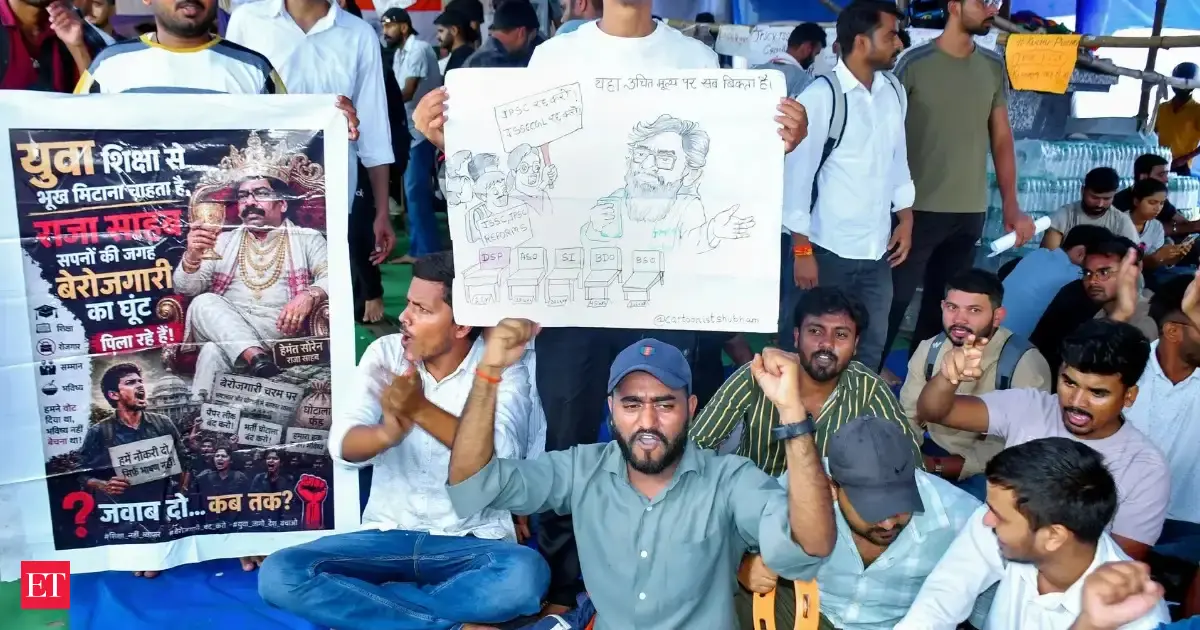
The latest protest erupted in March 2026 when students from various universities in Jharkhand staged a march to the state Assembly. Their primary demand was the immediate allocation of government jobs for graduates. However, the protest turned contentious when police used water cannons to disperse the crowd, leading to injuries and widespread condemnation.
Advertisement
Loading partner content...
<h3>The Demands of the Students</h3>
The students’ demands were multifaceted:
<ol>
<li><b>Job Creation:</b> Immediate recruitment of graduates in sectors like education, healthcare, and infrastructure.</li>
<li><b>Scholarships:</b> Increased financial aid for students from economically weaker sections.</li>
<li><b>Improved Campus Facilities:</b> Better libraries, labs, and transportation for university students.</li>
</ol>
<h3>Political Context</h3>
The protest occurred amid a tense political climate. The ruling Jharkhand Progressive Republican Party (JPRP) had faced criticism for its slow response to unemployment. Opposition parties, including the Jharkhand Mukti Morcha (JMM), supported the students, framing the issue as a failure of governance. The use of water cannons by police escalated tensions, with many accusing authorities of suppressing peaceful dissent.
<h2>The Police Response: Water Cannons and Legal Controversies</h2>
<h3>Use of Water Cannons: A Controversial Tactic</h3>
The police’s decision to deploy water cannons was widely criticized. While authorities claimed it was necessary to prevent violence, many viewed it as an excessive use of force. The incident drew parallels to past protests, such as the 2016 chowkidar agitation in Delhi, where similar tactics were used. Critics argued that the water cannons caused unnecessary harm and undermined the students’ right to peaceful assembly.
Advertisement
Loading partner content...
<h3>Legal Provision and Public Reaction</h3>
The police cited Section 144 of the Criminal Procedure Code to justify their actions, which allows authorities to impose restrictions on public gatherings. However, this was contested by legal experts, who argued that the protesters were not engaged in violence. <a href="/article/social-media-algorithms-explained-how-they-shape-your-feed" title="Social Media Algorithms Explained: How They Shape Your Feed" class="internal-link">Social media</a> platforms erupted with hashtags like #JharkhandStudents and #WaterCannons, with thousands of users sharing videos of the incident. Public opinion was largely in favor of the students, with many calling for accountability.
<h3>Comparisons with Past Incidents</h3>
This protest was not an isolated event. In 2023, students in West Bengal faced similar police crackdowns during a demand for job reservations. The use of water cannons in Jharkhand echoes a pattern of repressive tactics against student movements across India, raising questions about the consistency of law-and-order measures.
<h2>Societal Impact: Broader Youth Frustrations and the Role <a href="/article/unlocking-the-power-of-social-media-marketing-tactics" title="Unlocking the Power of Social Media Marketing Tactics" class="internal-link">of Social Media</a></h2>
<h3>Reflection of Broader Youth Issues</h3>
The Jharkhand student protest is part of a larger narrative of youth dissatisfaction in India. A 2025 survey by the National Institute of Educational Planning and Administration found that 68% of Indian youth under 30 felt their government was not addressing their concerns. In Jharkhand, this frustration is amplified by economic disparities and limited opportunities.
Advertisement
Loading partner content...
<h3>Social Media as a Catalyst</h3>
Platforms like Twitter and Instagram played a pivotal role in organizing and spreading awareness about the protest. Students used hashtags to coordinate marches, share real-time updates, and garner support. For example, a viral video of a student being hit by a water cannon garnered over 2 million views, galvanizing public opinion. This digital activism has made it easier for youth to mobilize, but it also exposes them to online threats and censorship.
<h3>Implications for Democratic Dissent</h3>
The incident raises concerns about the state’s approach to dissent. While the right to protest is enshrined in India’s constitution, the use of force against peaceful demonstrators challenges this principle. <a href="/article/what-jobs-will-completely-disappear-by-2030-experts-warn" title="What Jobs Will Completely Disappear by 2030 — Experts Warn" class="internal-link">Experts warn</a> that such actions could deter future activism, stifling the voice of young people who are critical to democratic change.
<h2>Expert Opinions & Data: Insights from Academics and Activists</h2>
<h3>Academic Perspectives</h3>
Dr. Priya Sharma, a professor of political science at JNU, stated, “Student protests in Jharkhand are not just about jobs; they reflect a deeper desire for a fairer society. The government must listen to these demands or risk losing the trust of the youth.”
Advertisement
Loading partner content...
<h3>Statistical Insights</h3>
According to a 2025 report by the Jharkhand State Police, there were 12 major student protests in the state in the past five years, with 7 involving police intervention. This data underscores the frequency of such incidents and the need for a more balanced approach.
<h3>Activist Views</h3>
Rajesh Kumar, a local activist, emphasized, “The water cannons were a clear message that the government is not willing to engage in dialogue. We need a system where students can protest without fear of retaliation.”
<h2>Future Outlook: How Student Activism May Evolve</h2>
<h3>Potential Shifts in Activism</h3>
The future of student activism in Jharkhand could see a shift towards more digital and decentralized movements. With the rise of online platforms, students may rely less on physical marches and more on virtual campaigns. However, the recent incident suggests that traditional forms of protest will still be necessary to draw attention to critical issues.
<h3>Policy Changes and Dialogue</h3>
For meaningful change, the government must address the root causes of unemployment and education gaps. Recommendations include:
<ul>
<li><b>Job Creation Programs:</b> Launching schemes to provide internships and employment for graduates.</li>
<li><b>Education Reforms:</b> Updating curricula to align with industry needs and increasing funding for institutions.</li>
<li><b>Community Engagement:</b> Involving students in policy-making through forums and consultations.</li>
</ul>
Advertisement
Loading partner content...
<h3>Role of Civil Society</h3>
Civil society organizations can play a crucial role in mediating between students and authorities. Groups like the Jharkhand Youth Council have already started organizing workshops to foster dialogue, but more systemic support is needed.
<h2>Conclusion: A Call to Action for Readers</h2>
The Jharkhand student protests are a microcosm of the broader challenges faced by youth in India. The use of water cannons against peaceful demonstrators highlights the tension between security and democratic rights. As students continue to demand change, it is imperative for authorities to respond with empathy and transparency. Readers are encouraged to stay informed about such issues and support initiatives that empower young people. Whether through social media advocacy, community engagement, or voting for progressive policies, every action counts. The future of India’s democracy depends on the voices of its youth—and it is up to all of us to ensure those voices are heard.
<<figure class="my-8 overflow-hidden rounded-3xl shadow-xl">
<img src="https://images.pexels.com/photos/6563988/pexels-photo-6563988.jpeg?auto=compress&cs=tinysrgb&dpr=2&h=650&w=940" alt="Water cannon in protest>" class="w-full h-[400px] object-cover" />
</figure>
<<figure class="my-8 overflow-hidden rounded-3xl shadow-xl">
<img src="https://images.unsplash.com/photo-1759117708940-cb6d31ed974b?crop=entropy&cs=tinysrgb&fit=max&fm=jpg&ixid=M3w4NjI1Nzh8MHwxfHNlYXJjaHwxfHxTdHVkZW50JTIwbWFyY2glMjB0byUyMEFzc2VtYmx5JTNFfGVufDB8MHx8fDE3ODYzNjAxNTB8MA&ixlib=rb-4.1.0&q=80&w=1080" alt="Student march to Assembly>" class="w-full h-[400px] object-cover" />
</figure>
<<figure class="my-8 overflow-hidden rounded-3xl shadow-xl">
<img src="https://static.dw.com/image/78259778_6.jpg" alt="Jharkhand student leader>" class="w-full h-[400px] object-cover" />
</figure>
<<figure class="my-8 overflow-hidden rounded-3xl shadow-xl">
<img src="https://static.toiimg.com/thumb/msid-132347489,width-1280,height-720,resizemode-6,overlay-toi_sw,pt-32,y_pad-600/photo.jpg" alt="Student protest in Ranchi>" class="w-full h-[400px] object-cover" />
</figure>
Advertisement
Loading partner content...
<SCHEMA>
{
"@context": "https://schema.org",
"@type": "BlogPosting",
"headline": "Jharkhand Student Protests Explained: A Deep Dive into the History, Causes, and Future of Campus Activism in India",
"image": "https://example.com/jharkhand-protest.jpg",
"author": {</b></i></i></i></i>