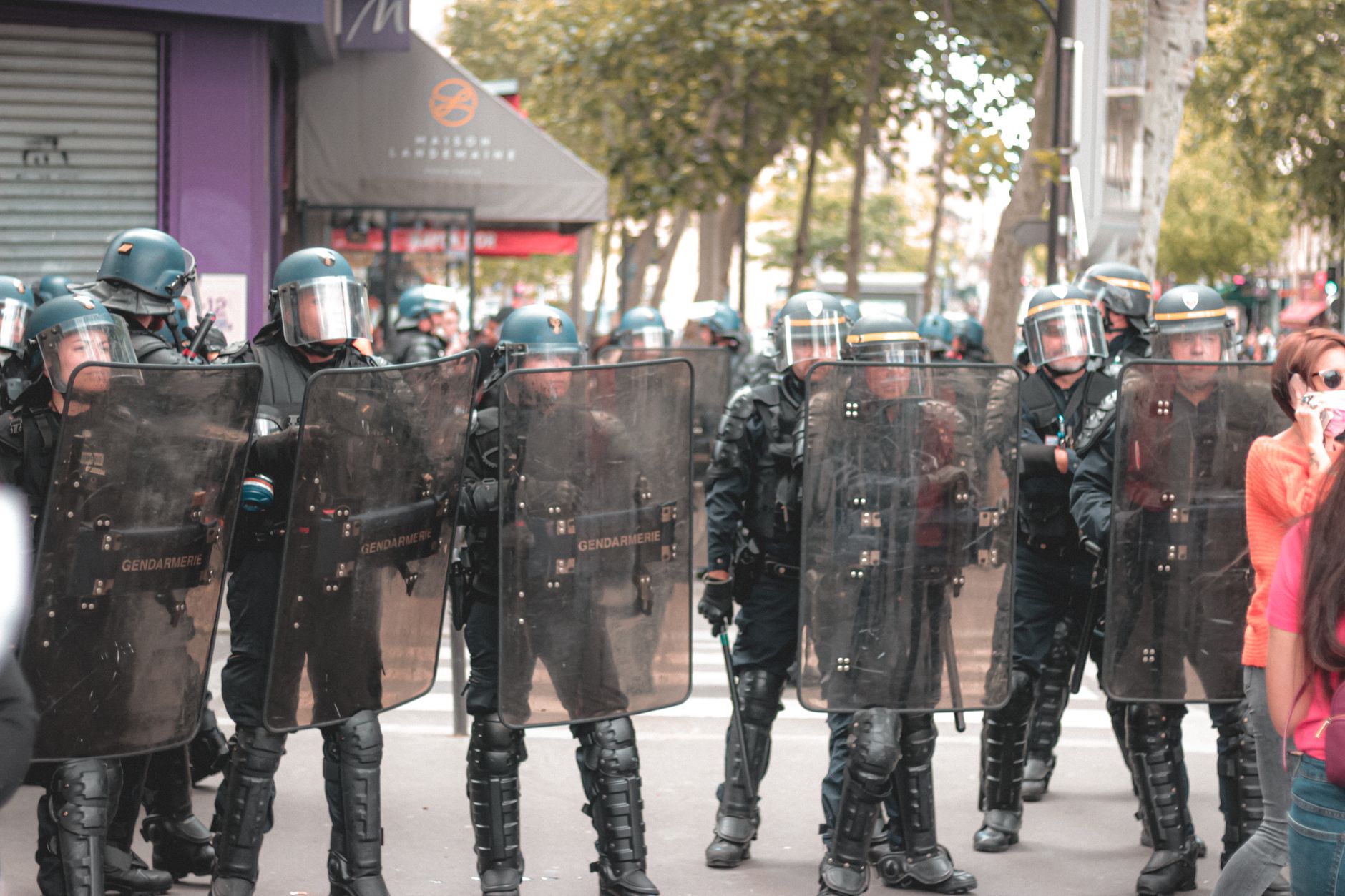
SUGGESTED ARTICLE TITLE: "France’s Protest Wars: The History, Politics and Future of Policing Mass Unrest" CREATIVE ARTICLE ANGLE & WRITING INSTRUCTIONS: Write a 1200+ word evergreen, deeply reported and engaging feature examining how France balances protest rights, public safety and police authority during periods of mass unrest. Open with the dramatic claim that police “lost control,” but clearly distinguish political rhetoric, eyewitness testimony, official findings and independently verified evidence rather than treating the minister’s statement as settled fact. Explain who the Interior Minister is, how responsibility for national public order is divided, and why disputed accounts of crowd behavior and police intervention often produce competing narratives. Build the article around the central tension between France’s reputation as a nation of demonstrations and its increasingly militarized approach to crowd control. Trace the historical roots of French protest culture from the Paris Commune and May 1968 through contemporary labor, pension, climate and Yellow Vest movements. Introduce the institutions and forces involved, including the Police Nationale, Gendarmerie, CRS units, prefects, municipal forces and prosecutors, while clarifying the differences between public-order units, intervention units and mobile brigades. Examine the legal framework governing demonstrations, bans, dispersals, identity checks, preventive detention, weapons and use of force, including the role of the Code pénal, Loi de 1990, 2001 and 2017 statutes, and European human-rights obligations. Explain how tactics have evolved, from informal crowd steering and physical intervention to surveillance drones, social-media monitoring, body cameras where applicable, armored vehicles, sound systems, water cannon and flash-ball systems. Assess which technologies have improved safety, which have deepened surveillance concerns, and how their use is challenged in French courts and by the European Court of Human Rights. Analyze the psychology and choreography of protest movements, including how organizers use symbolic locations, demonstrations, blockades, civil disobedience and digital mobilization to attract attention. Give balanced attention to protesters’ right to assemble, residents’ need for access and safety, and the difficult operational choices facing commanders confronting ambiguous crowd behavior. Include clear, non-sensational discussion of alleged excessive force, property damage, violence against protesters and police injuries, while emphasizing that allegations must be evaluated against documentary evidence, medical findings, judicial procedures and official investigations. Explore public trust: why repeated confrontations can erode confidence in the police, how viral videos reshape public opinion, and why the visual experience of unrest often differs from what occurs across an entire demonstration. Examine the role of the media, political leaders, activist groups, social media and contested figures who can inflate unrest for political advantage. Assess the consequences for France’s democratic culture, including whether heavy-handed policing suppresses protest without resolving the grievances that fuel it, and whether stronger enforcement can undermine the legitimacy of public institutions. Look comparatively at protest policing in countries such as Germany, the United Kingdom, the United States and Belgium, focusing on legal safeguards, specialist units, restraint rules, compensation and accountability without turning the piece into a simplistic ranking. Present practical takeaways for readers, journalists, policymakers, protest organizers and residents: how to document events lawfully, what credible accountability mechanisms should look like, how authorities can plan for medical support and de-escalation, and how communities can rebuild trust after a disputed confrontation. Conclude with a forward-looking analysis of the forces likely to shape the next decade, including climate and pension protests, gig-worker and labor unrest, urban inequality, misinformation, surveillance technology, women’s safety in demonstrations, prison overcrowding, police staffing and the need for transparent evidence. Maintain a neutral, authoritative and culturally informed tone, use vivid historical examples, explain technical terms on first mention and propose concrete reforms such as independent use-of-force investigations, clearer command responsibility, better training, public transparency, proportional enforcement and stronger channels for resolving social disputes without violence. FOCUS KEYWORDS TO INTEGRATE: French protests, protest policing in France, public order policing, police tactics in France
SUGGESTED ARTICLE TITLE: "France’s Protest Wars: The History, Politics and Future of Policing Mass Unrest" CREATIVE ARTICLE ANGLE & WRITING INSTRUCTIONS: Write ...
Loading partner content...
Loading partner content...
Related Articles
Why Jharkhand Students Are Protesting: A Deep Dive into Education Rights, Government Response, and the Role of Public Figures like Rahul Gandhi
10 Aug 2026

Guardians of Faith: The Resilience of Hindu Temples in America Amid Rising Threats and Miraculous Saves
15 Oct 2026

Beyond the Headlines: A Comprehensive Guide to India’s Dowry Death Laws, High‑Profile Cases, and How They Shape Society
25 May 2026

Twisha Sharma Dowry Death Case: Legal Battle, Societal Impact & Reforms in India
28 May 2026