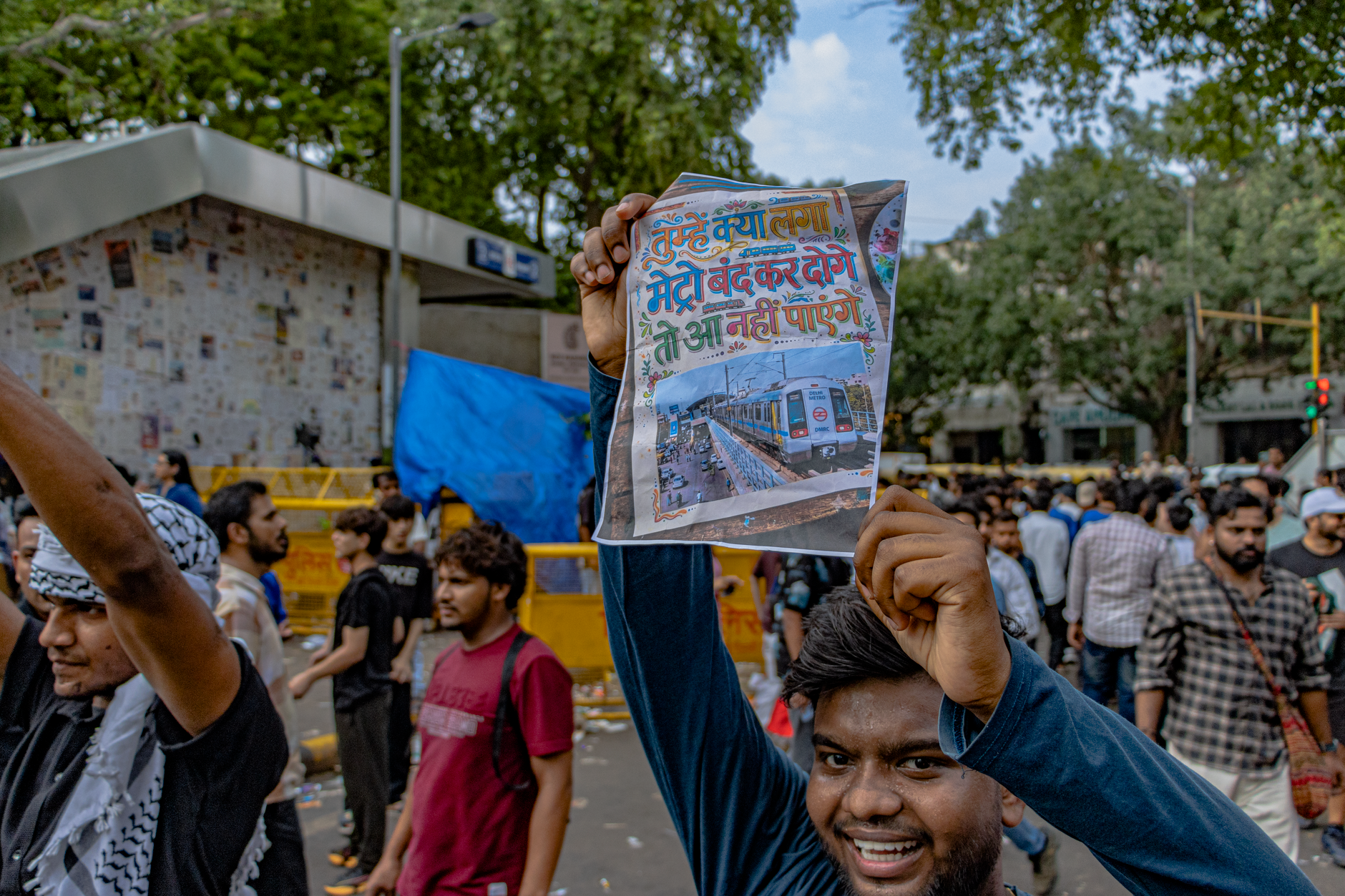

<h1>Thousands of security personnel deployed as Delhi braces for ‘cockroach’ protest</h1>
<p>In the bustling, vibrant, and often chaotic heart of India, the capital city of Delhi frequently serves as the ultimate stage for societal drama, cultural shifts, and fierce civic expressions. Recently, the city found itself at the center of a bizarre yet highly symbolic standoff as thousands of security personnel were deployed to brace for what has been dubbed the <b>‘cockroach protest’</b>. This unusual trending subject highlights the fascinating intersection of grassroots satire, urban governance, and the heavy hand of state security in the modern era. It is a story not just about a tiny insect, but about the deep-seated anxieties, frustrations, and creative resilience of a society in constant flux.</p>
<figure class="my-8 overflow-hidden rounded-3xl shadow-xl">
<img src="https://images.pexels.com/photos/16136355/pexels-photo-16136355.jpeg?auto=compress&cs=tinysrgb&dpr=2&h=650&w=940" alt="Delhi street crowd protest atmosphere" class="w-full h-[400px] object-cover" />
</figure>
<h2>The Metaphor of the Cockroach: Why Citizens Choose This Symbol</h2>
Advertisement
Loading partner content...
<p>To understand the sheer magnitude of the security response, one must first unpack the cultural and societal weight of the humble cockroach. In the collective urban imagination of India, the cockroach is not merely a household pest; it is a powerful metaphor. It represents <b>extreme resilience, survival against all odds, and the persistent, unwanted presence</b> of systemic neglect. When citizens organize a protest using the cockroach as their mascot, they are engaging in a rich tradition of political satire.</p>
<p>They are drawing a parallel between the survival of pests in a poorly managed urban ecosystem and the survival of bureaucratic red tape, corruption, or civic apathy within the administrative machinery.</p>
<p>This form of protest is deeply rooted in the <b>Society & Culture</b> of urban India, where humor is often the only safe weapon for the marginalized or frustrated <a href="/article/why-india-s-middle-class-is-more-stressed-than-ever" title="Why India’s Middle Class Is More Stressed Than Ever" class="internal-link">middle class</a> to voice their dissent. Rather than direct, aggressive confrontation, which can be easily suppressed or criminalized, a satirical protest using a symbol like a cockroach diffuses tension while delivering a sharp, unforgettable critique. It forces the administration to either look absurd by taking it too seriously or look negligent by ignoring the core message of filth and decay.</p>
<h3>The Psychology of Symbolic Resistance</h3>
<p>Symbolic protests have a long history globally, but in the context of a highly populated, diverse, and rapidly modernizing metropolis like Delhi, they carry unique weight. They tap into universal urban anxieties:</p>
<ul>
<li><b>Hygiene and Decay:</b> The literal fight against pest control in public offices and local neighborhoods.</li>
<li><b>Systemic Inefficiency:</b> The feeling that certain elements of the system are hard to eliminate, much like a cockroach surviving multiple chemical attacks.</li>
<li><b>Civic Pride vs. Administrative Neglect:</b> The frustration of seeing a world-class capital city struggle with basic civic cleanliness <a href="/article/how-india-s-supreme-court-balances-public-protests-and-infrastructure-a-comprehensive-guide" title="How India's Supreme Court Balances Public Protests and Infrastructure: A Comprehensive Guide" class="internal-link">and infrastructure</a>.</li>
</ul>
Advertisement
Loading partner content...
<figure class="my-8 overflow-hidden rounded-3xl shadow-xl">
<img src="https://images.pexels.com/photos/27055150/pexels-photo-27055150.jpeg?auto=compress&cs=tinysrgb&dpr=2&h=650&w=940" alt="symbolic pest control urban hygiene concept" class="w-full h-[400px] object-cover" />
</figure>
<h2>The Heavy Hand of the State: Security Logistics in the Capital</h2>
<p>The decision to deploy thousands of security personnel for a seemingly whimsical protest is a testament to the complex law-and-order dynamics of Delhi. The capital of India is a highly sensitive zone, hosting the central government, foreign embassies, and key judicial institutions. Any large gathering, regardless of its theme, poses a massive security challenge. The authorities cannot afford to overlook even a symbolic threat, as the capital's streets are often hotbeds for larger political movements and spontaneous escalations.</p>
<p>The massive security deployment reflects a cautious, sometimes overly cautious, approach to public gatherings <a href="/article/5g-technology-in-2026-revolutionizing-connectivity-and-shaping-india-s-digital-future" title="5G Technology in 2026: Revolutionizing Connectivity and Shaping India's Digital Future" class="internal-link">in 2026</a>. With <a href="/article/the-rise-of-the-cockroach-janta-party-india-s-quirky-political-movement-protest-culture-and-legal-ba" title="The Rise of the Cockroach Janta Party: India’s Quirky Political Movement, Protest Culture, and Legal Battles" class="internal-link">the rise of</a> rapid digital mobilization, a protest can scale up in numbers and intensity within hours. The security apparatus, therefore, prepares for the worst-case scenario, treating every public demonstration as a potential law-and-order challenge. This heavy presence is designed to deter violence, protect public infrastructure, and ensure that the symbolic message does not spiral into a physical confrontation between opposing groups.</p>
Advertisement
Loading partner content...
<h3>The Logistics of Crowd Control in a Megacity</h3>
<p>Managing a crowd in Delhi is a logistical nightmare. The city's infrastructure, despite massive modernization efforts, still struggles with narrow lanes, dense populations, and heavy traffic. Deploying thousands of personnel is not just about numbers; it is about creating a physical grid to guide the flow of people, prevent blockades, and ensure that key transit points remain functional. The security planning for the 'cockroach protest' would have involved:</p>
<ol>
<li><b>Intelligence Gathering:</b> Monitoring social media channels and citizen forums to gauge the expected turnout and the exact route of the march.</li>
<li><b>Physical Barriers:</b> Setting up barricades around sensitive administrative buildings to prevent the symbolic march from turning into an occupation of public spaces.</li>
<li><b>Rapid Response Teams:</b> Stationing mobile units across the city to handle any sudden escalation or unexpected clashes.</li>
</ol>
<figure class="my-8 overflow-hidden rounded-3xl shadow-xl">
<img src="https://images.pexels.com/photos/34585117/pexels-photo-34585117.jpeg?auto=compress&cs=tinysrgb&dpr=2&h=650&w=940" alt="security personnel crowd control public order" class="w-full h-[400px] object-cover" />
</figure>
<h2>Societal Reflections: What the ‘Cockroach’ Trend Tells Us About 2026 India</h2>
Advertisement
Loading partner content...
<p>This trending subject is more than just a quirky news headline; it is a mirror reflecting the current state of <b>Society & Culture</b> in India. The year 2026 is marked by rapid urbanization, high digital connectivity, and a growing demand for accountability from public institutions. Citizens are increasingly sophisticated in how they express their grievances. They understand <a href="/article/the-power-of-the-youth-a-deep-dive-into-the-history-and-impact-of-student-activism-in-india" title="The Power of the Youth: A Deep Dive into the History and Impact of Student Activism in India" class="internal-link">the power of</a> viral imagery, the utility of symbolic protests, and the importance of capturing public imagination.</p>
<p>The 'cockroach' protest taps into a collective fatigue with traditional politics. Instead of relying on established political parties or formal bureaucratic channels, which are often perceived as slow, corrupt, or unresponsive, citizens are inventing their own forms of direct action. This shift towards creative, citizen-led activism shows a vibrant, if frustrated, democracy at work. It demonstrates that the desire for clean, efficient, and responsive governance is alive and well, even if the methods used to achieve it are unconventional and humorous.</p>
<h3>The Role of Digital Media in Shaping the Narrative</h3>
<p>In the modern digital age, the success of a protest is often measured by its online footprint. The 'cockroach' theme is inherently highly shareable, visually striking, and ripe for memes. Social media platforms amplify these quirky movements, turning local citizen frustrations into national talking points. This digital amplification forces mainstream media and administrative bodies to pay attention, ensuring that the core message of civic neglect cannot be easily swept under the carpet.</p>
Advertisement
Loading partner content...
<blockquote>
<p>"The cockroach does not ask for permission to survive; it finds a way. In the same way, the citizens of our capital are finding creative ways to demand a cleaner, more accountable system. The heavy security deployment might stop the physical march, but it cannot stop the idea from spreading."</p>
<footer>— Civic Observer & Cultural Analyst</footer>
</blockquote>
<h2>The Broader Cultural Landscape of Citizen Activism</h2>
<p>Looking at the broader cultural landscape, the 'cockroach protest' is part of a global wave of unconventional civic expressions. From Chile's student protests to the humorous stunts of European climate activists, citizens worldwide are turning away from formal, institutionalized forms of dissent. They are adopting humor, satire, and local symbols to make global or national issues feel personal and urgent.</p>
<p>In India, this trend is particularly powerful because it bridges the gap between the highly educated, English-speaking urban elite and the local, vernacular-speaking masses. A symbol like the cockroach is universally understood across all linguistic and social barriers. It is a shared experience of urban living—everyone knows what it is like to open a kitchen cabinet and find an unwanted guest. This shared experience forms the basis of a powerful, unified civic voice.</p>
Advertisement
Loading partner content...
<h3>A Comparison of Modern Protest Symbols and Their Meanings</h3>
<table>
<thead>
<tr>
<th>Protest Symbol / Trend</th>
<th>Primary Meaning / Target</th>
<th>Typical Administrative Response</th>
</tr>
</thead>
<tbody>
<tr>
<td><b>The Cockroach</b></td>
<td>Systemic filth, resilience of corruption, bureaucratic pests.</td>
<td>Heavy security deployment, symbolic sanitation drives.</td>
</tr>
<tr>
<td><b>The Candle / Light March</b></td>
<td>Peaceful mourning, demand for justice, hope against darkness.</td>
<td>Police escorts, traffic restrictions, high vigilance.</td>
</tr>
<tr>
<td><b>Chai Pe Charcha (Tea Talks)</b></td>
<td>Informal political dialogue, grassroots policy discussions.</td>
<td>Local police permission, media monitoring, soft surveillance.</td>
</tr>
<tr>
<td><b>Hash Tag / Digital Strike</b></td>
<td>Virtual boycott, narrative warfare, digital awareness.</td>
<td>Internet shutdowns (rarely), platform takedown requests.</td>
</tr>
</tbody>
</table>
<figure class="my-8 overflow-hidden rounded-3xl shadow-xl">
<img src="https://images.pexels.com/photos/6638839/pexels-photo-6638839.jpeg?auto=compress&cs=tinysrgb&dpr=2&h=650&w=940" alt="symbolic protest art creative resistance" class="w-full h-[400px] object-cover" />
</figure>
<h2>Conclusion: The Unyielding Voice of the Citizen</h2>
Advertisement
Loading partner content...
<p>The deployment of thousands of security personnel in Delhi for the 'cockroach protest' ultimately underscores a fundamental truth: the human spirit, particularly the spirit of civic engagement and the desire for justice, is incredibly hard to suppress. While the physical presence of security forces may temporarily manage the streets and keep the peace, they cannot extinguish the spark of creativity and frustration that drives citizens to organize.</p>
<p>As India continues to navigate the complexities of the 21st century, the <b>Trending Subject</b> of the cockroach protest serves as a vital reminder of the power of civil society. It shows that governance is not just about laws and security apparatuses; it is about listening to the quiet, often humorous, but persistent voices of the people. The cockroach, in its own small way, has become a champion of civic expression, proving that even the smallest symbol can trigger a massive conversation about the future of our cities, our society, and our collective culture.</p></b></i></i></i></i>