<h1>When Democracy Turns Against Its Own: The Unprecedented Protests Against <a href="/article/safe-sustainable-weight-loss-strategies-for-a-healthier-india" title="Safe & Sustainable Weight Loss Strategies for a Healthier India" class="internal-link">India</a>'s Chief Election Commissioner and the Crisis of Electoral Integrity</h1>
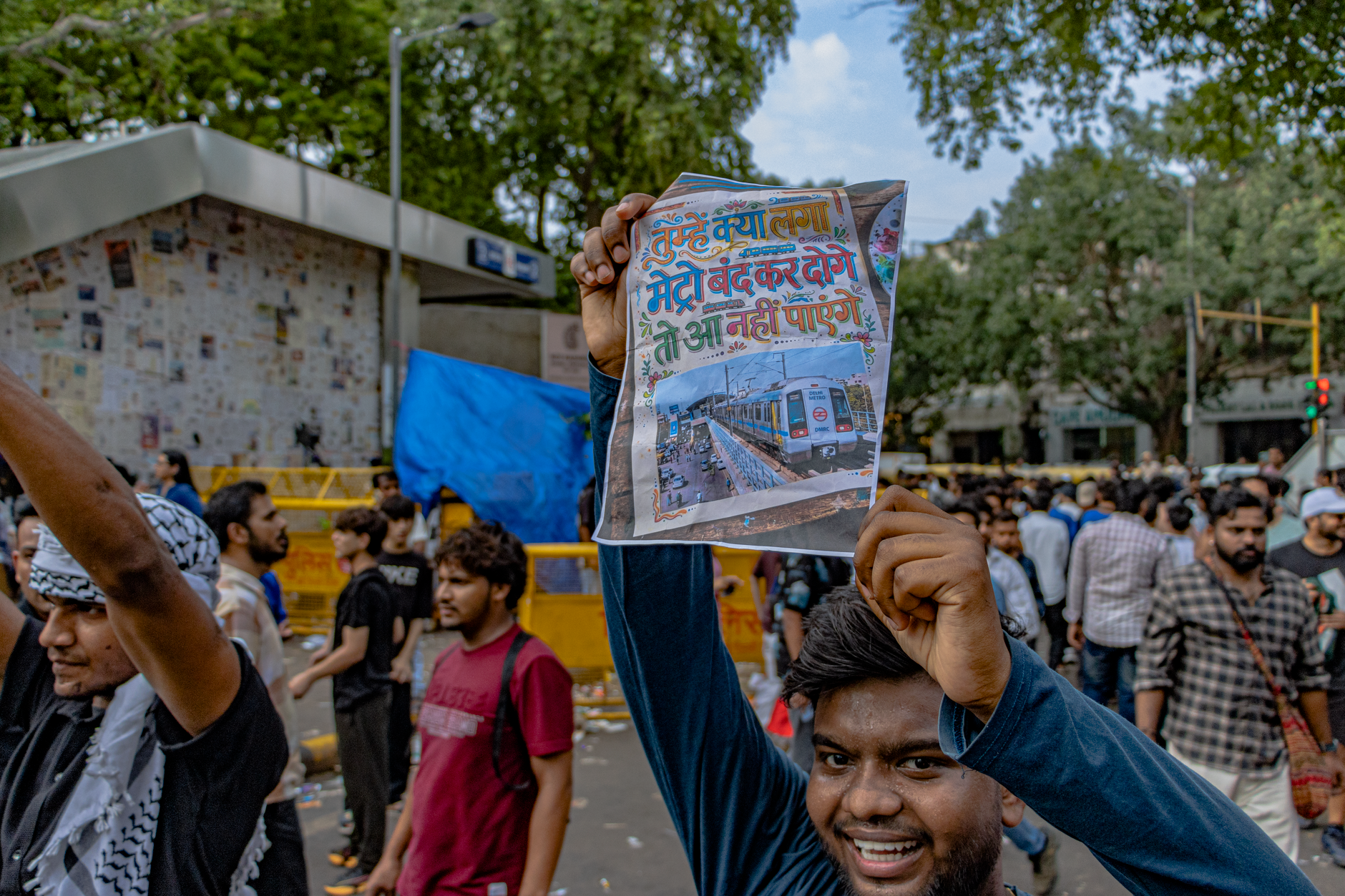
<p>The recent wave of demonstrations calling for the resignation of India’s Chief Election Commissioner (CEC) has shaken the nation’s political landscape. Protesters argue that the commissioner’s actions threaten electoral integrity and undermine public trust in democratic institutions. This article examines the roots of the movement, its historical echoes, <a href="/article/the-power-of-the-youth-a-deep-dive-into-the-history-and-impact-of-student-activism-in-india" title="The Power of the Youth: A Deep Dive into the History and Impact of Student Activism in India" class="internal-link">the power</a> struggles it has ignited, and what it means for India’s democratic future.</p>
<h2>Origins and Context</h2>
<p>The controversy began after a series of high‑profile decisions by the CEC that opposition parties labelled as biased. Critics point to the handling of voter‑ID verification in several border states and the timing of election announcements that appeared to favour the ruling coalition. These actions have been framed as part of a broader pattern of institutional capture.</p>
<ul>
<li><b>Voter‑ID delays</b> in Assam and West Bengal led to allegations of disenfranchising minority communities.</li>
<li><b>Election schedule shifts</b> were perceived as advantageous to incumbent parties during crucial legislative sessions.</li>
<li><b>Public statements</b> by the CEC that downplayed concerns about electronic voting machine (EVM) security sparked outrage among civil society groups.</li>
<li><b>Alleged conflicts of interest</b> arose after reports of the CEC’s family members holding positions in firms contracted for election logistics.</li>
</ul>
<figure class="my-8 overflow-hidden rounded-3xl shadow-xl">
<img src="https://images.pexels.com/photos/11621838/pexels-photo-11621838.jpeg?auto=compress&cs=tinysrgb&dpr=2&h=650&w=940" alt="India protest" class="w-full h-[400px] object-cover" />
</figure>
<h2>Historical Precedents</h2>
<p>India’s electoral history is not unfamiliar with controversies surrounding the CEC. Past episodes show how institutional credibility can erode when perceived partisanship surfaces. Understanding these precedents helps gauge the severity of the current crisis.</p>
<table>
<thead>
<tr>
<th>Year</th>
<th>Controversy</th>
<th>Outcome</th>
</tr>
</thead>
<tbody>
<tr>
<td>1975</td>
<td>CEC accused of enabling the Emergency‑era suspension of elections</td>
<td>Public backlash contributed to the eventual lifting of the Emergency</td>
</tr>
<tr>
<td>1998</td>
<td>Allegations of favouritism in allocating election symbols</td>
<td>Parliamentary committee recommended stricter guidelines</td>
</tr>
<tr>
<td>2004</td>
<td>Questions over the independence of the CEC during the Gujarat riots</td>
<td>Supreme Court intervened to affirm the EC’s autonomy</td>
</tr>
<tr>
<td>2019</td>
<td>Debate over the timing of election dates in Jammu & Kashmir</td>
<td>EC defended its schedule; protests subsided after assurances</td>
</tr>
</tbody>
</table>
<figure class="my-8 overflow-hidden rounded-3xl shadow-xl">
<img src="https://www.aljazeera.com/wp-content/uploads/2026/10/reuters_6abf89ee-1790937582.jpg?resize=1920%2C1440" alt="Chief Election Commissioner of India" class="w-full h-[400px] object-cover" />
</figure>
Advertisement
Loading partner content...
<h2>The Power Dynamics</h2>
<p>The protests have exposed a tug‑of‑war between the Election Commission, the executive branch, and a mobilised civil society. While the CEC claims constitutional independence, demonstrators argue that recent decisions reflect executive influence. This tension raises fundamental questions about the balance of power <a href="/article/social-norms-and-behavioral-change-how-culture-shapes-our-daily-choices-in-india" title="Social Norms and Behavioral Change: How Culture Shapes Our Daily Choices in India" class="internal-link">in India</a>’s federal structure.</p>
<blockquote>
<p><b>“When the guardian of the ballot appears to tilt the scale, the very foundation of democracy trembles.”</b> – Statement from a coalition of NGOs, March 2026</p>
</blockquote>
<figure class="my-8 overflow-hidden rounded-3xl shadow-xl">
<img src="https://s.yimg.com/lo/mysterio/api/eb6b13441e177fc5e6f96e7509b0223a0e4a1ef4d39b3718b235e4023fde9829/lightyear_networkapi/resizefill_w420_h315%3Bquality_80%3Bformat_webp/https%3A%2F%2Fmedia.zenfs.com%2Fen%2Fjacobin_644%2F4855e67be1554ae9dc13c843b468d645.jpg" alt="Indian election 1975" class="w-full h-[400px] object-cover" />
</figure>
<h2>Societal Implications</h2>
<p>The unrest is more than a dispute over one official; it mirrors deeper anxieties about minority representation, the credibility of electoral mechanisms, and the health of democratic norms. Many citizens fear that if the CEC’s office is perceived as compromised, future elections could be contested on the streets rather than at the ballot box.</p>
<ol>
<li><b>Erosion of trust</b>: Surveys show a 12‑point drop in confidence in the Election Commission since January 2026.</li>
<li><b>Minority concerns</b>: Muslim and tribal groups report heightened fear of voter suppression.</li>
<li><b>Activist mobilization</b>: The protests have united student unions, <a href="/article/how-india-s-5-point-maritime-trade-blueprint-is-redefining-global-shipping-a-complete-guide" title="How India’s 5‑Point Maritime Trade Blueprint Is Redefining Global Shipping – A Complete Guide" class="internal-link">trade</a> unions, and regional parties under a common banner.</li>
<li><b>Policy pressure</b>: Opposition parties are demanding parliamentary reforms to strengthen the CEC’s appointment process.</li>
</ol>
<h2>Future Outlook</h2>
<p>Looking ahead, several scenarios could unfold depending on the CEC’s response and judicial interventions. The resolution will likely shape not only the immediate political climate but also the long‑term perception of electoral fairness in India.</p>
<ul>
<li><b>Voluntary resignation</b>: If the CEC steps down, it could quell protests but may be seen as a victory for street power over institutional norms.</li>
<li><b>Judicial review</b>: <a href="/article/the-supreme-court-s-investigation-into-bci-chairmanship-s-impact-on-nalsar-students-a-deep-dive-into" title="The Supreme Court's Investigation into BCI Chairmanship's Impact on NALSAR Students: A Deep Dive into Institutional Authority, Legal Accountability, and Academic Freedom" class="internal-link">The Supreme</a> Court may be petitioned to assess the constitutionality of recent decisions, potentially reinforcing judicial oversight.</li>
<li><b>Legislative reform</b>: Parliament could amend the Election Commission Act to introduce collegial appointments and greater transparency.</li>
<li><b>Prolonged standoff</b>: Refusal to resign might deepen polarisation, leading to sustained protests and possible international scrutiny.</li>
</ol>
Advertisement
Loading partner content...
<h2>Global Comparison</h2>
<p>India is not alone in facing challenges to electoral authority. Comparing its situation with other democracies offers insight into what strategies have succeeded or failed elsewhere.</p>
<table>
<thead>
<tr>
<th>Country</th>
<th>Issue</th>
<th>Movement Outcome</th>
<th>Lesson for India</th>
</tr>
</thead>
<tbody>
<tr>
<td>United States (2020)</td>
<td>Claims of election fraud targeting state officials</td>
<td>Officials held their ground; courts dismissed most claims</td>
<td>Robust judicial independence can deter unfounded allegations</td>
</tr>
<tr>
<td>Kenya (2017)</td>
<td>Protests against the IEBC chairman over alleged bias</td>
<td>Chairman resigned after Supreme Court annulled election</td>
<td>Judicial intervention can enforce accountability</td>
</tr>
<tr>
<td>Brazil (2022)</td>
<td>Accusations of partisan influence in the Federal Election Tribunal</td>
<td>Public pressure led to reforms in appointment procedures</td>
<td>Transparent reforms can restore credibility</td>
</tr>
<tr>
<td>Hungary (2022)</td>
<td>Allegations of electoral commission bias favouring the ruling party</td>
<td>Commission retained power; EU criticized democratic backsliding</td>
<td>External scrutiny alone may not reverse internal capture</td>
</tr>
</tbody>
</table>
<figure class="my-8 overflow-hidden rounded-3xl shadow-xl">
<img src="https://images.unsplash.com/photo-1644093302739-1b4c235bfa80?crop=entropy&cs=tinysrgb&fit=max&fm=jpg&ixid=M3w4NjI1Nzh8MHwxfHNlYXJjaHwxfHx3b3JsZCUyMGVsZWN0aW9ufGVufDB8MHx8fDE3OTExMzY3ODl8MA&ixlib=rb-4.1.0&q=80&w=1080" alt="world election" class="w-full h-[400px] object-cover" />
</figure>
<p>The protests against India’s Chief Election Commissioner reveal a critical juncture for the nation’s democratic experiment. Whether the current crisis leads to meaningful reform, a renewed commitment to institutional independence, or further erosion of public faith will depend on the choices made by leaders, judges, and citizens alike. Safeguarding electoral integrity is not merely a technical concern; it is the bedrock upon which India’s democratic resilience rests.</p></b></ul></i></i></i></i>