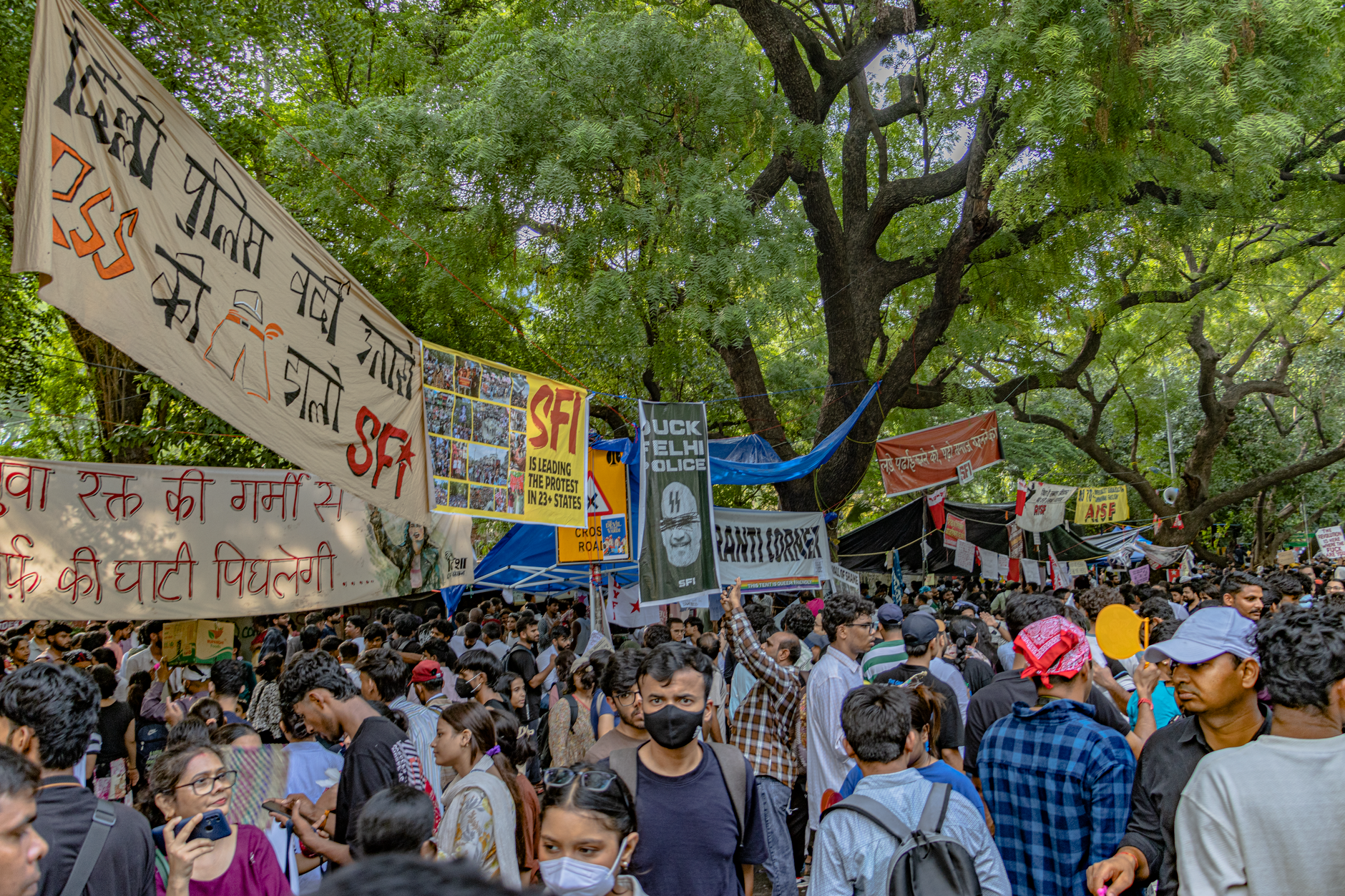
<h1>The Legal Geometry of Dissent: How India's Supreme Court Balances Protest Rights & Public Livelihood</h1>
<p>The fundamental tension at the heart of Indian constitutional law lies in the collision between two equally sacrosanct rights: the right to speak and assemble and the right to live and earn a livelihood. Article 19(1)(a) and (b) protect the freedom of speech and assembly, guaranteeing citizens the ability to express their thoughts and gather peacefully. Yet Article 19(1)(g) and Article 21 simultaneously safeguard the right to life and personal liberty, including the right of daily wage earners and commuters to live with dignity. When these two pillars clash in the cityscape, <a href="/article/the-supreme-court-s-investigation-into-bci-chairmanship-s-impact-on-nalsar-students-a-deep-dive-into" title="The Supreme Court's Investigation into BCI Chairmanship's Impact on NALSAR Students: A Deep Dive into Institutional Authority, Legal Accountability, and Academic Freedom" class="internal-link">the Supreme</a> Court becomes the arbiter.</p>
<p>This article examines how India's highest judicial body has navigated this constitutional quagmire, from the colonial-era restrictions of the Police Act, 1861 and Section 144 of the CrPC to the landmark rulings of the Shaheen Bagh and Farmers' protests. It provides a definitive guide to the legal principles governing the occupation of public spaces for protests, the "Designated Protest Zones" framework, and the ongoing negotiation between public order and fundamental rights.</p>
<h2>Introduction: The Collision of Two Fundamental Rights</h2>
<p>India's constitutional democracy rests on the delicate balance between individual freedoms and collective welfare. The right to protest, enshrined in Article 19(1)(a), allows citizens to assemble for the free expression of opinions and to speak freely without censorship. This right has been the lifeblood of India's political evolution, from the independence movement to contemporary social justice struggles. Yet the right to live, guaranteed under Article 21, equally protects citizens from conditions that undermine their dignity and safety.</p>
<p>This protection extends to the right of daily wage earners, street vendors, and commuters whose livelihoods depend on the free flow of public spaces. When protesters occupy roads, block highways, and halt markets, they simultaneously exercise their Article 19 rights and potentially violate Article 21 by disrupting the public order and the livelihood of others. The concept of "public space" in India is thus a contested resource—neither entirely the domain of the state nor entirely the domain of citizens. The Supreme Court has developed a sophisticated jurisprudence to navigate this collision, creating a legal framework that attempts to reconcile these competing interests while preserving the essential character of both rights.</p>
Advertisement
Loading partner content...
<h2>Historical Context: From Colonial Law to Constitutional Right</h2>
<p>The legal landscape surrounding public assembly in India was largely shaped by colonial-era laws before the Constitution was adopted in 1950. The Police Act, 1861, and particularly Section 144 of the CrPC provided sweeping powers for law enforcement to prohibit assemblies deemed to threaten public order. These provisions were broad in scope, allowing authorities to ban gatherings without rigorous justification, thereby effectively criminalizing dissent before the constitutional framework existed. The absence of a constitutional right to protest meant that the state held unchecked power to restrict assembly, and the judiciary rarely intervened in such matters.</p>
<p>The transition to a constitutional democracy brought about a significant shift. The Supreme Court of India, in cases like Himat Lal K. Shah v. Commissioner of Police (1973), began to recognize that the right to assemble was not merely a formal right but a substantive one protected by Article 19.</p>
<p>The Court acknowledged that while the state has the power to regulate assemblies, such power must be exercised with caution and proportionality. This marked the beginning of a jurisprudential journey toward establishing a balance between public order and fundamental rights. The post-constitutional era saw further development through cases like Ramlila Maidan Incident v. Home Secretary, Union of India (2012), which affirmed the right to protest in the context of the Ramlila Maidan peaceful demonstration.</p>
<p>Although the Court did not establish an absolute right to occupy public spaces, it did recognize that the right to protest can be exercised only within the confines of the law, and that the state has a duty to protect public order while respecting the dignity of citizens. This historical evolution laid the groundwork for the more nuanced rulings that would follow in the 21st century.</p>
<h2>The Turning Point: Shaheen Bagh & The "Indefinite Occupation" Doctrine</h2>
Advertisement
Loading partner content...
<p>The Shaheen Bagh verdict of 2020 represented a watershed moment in the legal geography of Indian protest. During the anti-CAA protests, thousands of citizens gathered at Shaheen Bagh, a stretch of New Delhi that served as a symbolic counterpoint to the Ramlila Maidan. The gathering became a focal point of the movement, drawing activists from across the country and transforming it into a prolonged standoff between the state and the protesting citizenry. In Amit Sahni v.</p>
<p>Commissioner of Police (2020), a three-judge bench delivered a landmark judgment that fundamentally reshaped the jurisprudence on public space occupation. " This ruling established what became known as the "indefinite occupation" doctrine, which distinguishes between the right to protest and the mode, place, and duration of that protest. The judgment emphasized that while citizens have the right to assemble peacefully, they cannot use public spaces for indefinite occupation that effectively paralyzes the city and disrupts the daily lives of millions. The Court's reasoning was grounded in the principle of proportionality—any restriction on protest must be necessary, reasonable, and proportionate to the legitimate state interest.</p>
<p>The ruling also highlighted the importance of "designated protest zones" as a mechanism to channel dissent into controlled and orderly spaces, rather than allowing unplanned occupations to spill over into the broader public domain. This decision sent a clear signal that the Supreme Court was willing to place limits on protest rights when public order and the fundamental rights of commuters are at stake. The Shaheen Bagh verdict has since become a touchstone in discussions about the boundaries of public assembly in India.</p>
<h2>The Current Flashpoint: Farmers' Protests & Highway Blockades</h2>
<p>The Farmers' protests of 2020-2021 brought similar tensions to the Supreme Court, though from a different angle. The movement, which began in 2020 and continued into 2021, sought to challenge three farm bills that the government argued would undermine farmers' rights to protect their crops and incomes. The movement escalated to highway blockades, particularly at the Delhi borders, where farmers and their supporters occupied major highways to create a visible and disruptive presence. In Rakesh Vaidhyanathan v.</p>
<p>Union of India (2021), the Supreme Court addressed the legal status and duration of these blockades. The Court applied the principle of "balance of convenience" to evaluate whether the government's interest in enforcing the law and maintaining public order outweighed the public's right to peaceful assembly and protest. The judgment specifically referenced the "livelihood of daily wagers" as a critical consideration—the economic dependence of millions of India's informal sector workers on daily wages and the disruption caused to supply chains and emergency services. The Court acknowledged that while the fundamental right to protest is protected, it is not absolute and must be balanced against the Article 21 rights of those affected by the occupation.</p>
<p>The "livelihood of daily wagers" became a powerful judicial recognition of the "silent majority's" Article 21 rights, signaling that the state cannot use public space to arbitrarily deny the basic economic security of its citizens. This ruling reinforced the legal framework established in earlier cases and provided a clear test for future protest-related litigation.</p>
Advertisement
Loading partner content...
<h2>The Legal Framework: The "Time, Place, Manner" Restrictions Test</h2>
<p>To understand <a href="/article/non-violence-vs-protection-how-the-supreme-court-redefines-protest-safety-in-india" title="Non-Violence vs. Protection: How the Supreme Court Redefines Protest Safety in India" class="internal-link">how the Supreme Court</a> balances protest rights and public livelihood, one must grasp the "time, place, and manner" restrictions test. This legal framework provides a structured approach to evaluating whether a restriction on protest is justifiable. The test rests on three prongs that together create <a href="/article/pellet-guns-in-protests-a-comprehensive-guide-to-their-use-impact-and-the-call-for-regulation" title="Pellet Guns in Protests: A Comprehensive Guide to Their Use, Impact, and the Call for Regulation" class="internal-link">a comprehensive</a> balance between competing constitutional interests.</p>
<p><b>Content Neutrality</b> is the first prong. Any restriction on a protest must not target the message or the content of the protest. For example, if a court bans a march demanding a specific policy change, it violates the principle of content neutrality. The restriction must be neutral with respect to the message being conveyed.</p>
<p>This ensures that the state does not use the regulatory mechanism to suppress particular viewpoints while allowing others to protest freely.</p>
<p><b>Narrow Tailoring</b> is the second prong, requiring that any permissible restriction must serve a significant government interest and be the least restrictive means to achieve that interest. The court must demonstrate that the restriction is necessary to protect public order, traffic safety, or the livelihood of commuters. A blanket ban on all protests in a public space would fail this test because it is not narrowly tailored—it affects all expression equally without distinguishing between legitimate concerns and arbitrary suppression.</p>
Advertisement
Loading partner content...
<p><b>Alternative Channels</b> constitute the third prong, demanding that the law provide ample opportunity for Protesters to communicate their message through other means. Designated protest zones, such as Jantar Mantar or Ramleela Maidan, serve this purpose by offering legal alternatives to unplanned occupations. When a designated zone is available, the restriction should direct protesters to that space rather than prohibiting the protest altogether. This approach recognizes that the right to protest is not about the method or location of the protest, but about the freedom to express one's concerns peacefully.</p>
<p>Together, these three prongs create a coherent legal framework that allows the state to regulate public assembly without undermining the core protections of the Constitution. The Supreme Court has consistently applied this framework in landmark judgments, ensuring that restrictions are proportional, necessary, and fair. However, the application of this framework is not without challenges, as seen in cases like Shaheen Bagh where the boundaries of "public space" and "indefinite occupation" remain contested.</p>
<h2>The Human Cost: Quantifying the "Daily Wager" Argument</h2>
<p>Beyond the legal abstractions, the right to protest must be understood through its human impact. The "livelihood of daily wagers" argument, which the Supreme Court explicitly recognized in the Farmers' protest case, represents a powerful judicial acknowledgment of the economic vulnerability of millions of India's informal workers. Daily wage earners—street vendors, auto-rickshaw drivers, delivery personnel, and countless others—depend on the free flow of public spaces for their survival. When protests occupy a highway or block a market, the disruption is not merely symbolic; it has concrete economic consequences.</p>
<p>Studies by various economic institutions have estimated the cost of such disruptions in terms of lost productivity, supply chain delays, and increased transportation costs. For instance, the temporary closure of major highways during protests can lead to significant delays in the delivery of perishable goods, affecting food security in urban areas. The auto-rickshaw drivers, who form the backbone of India's informal transportation network, face direct financial losses when their vehicles are stranded or unable to operate. Street vendors lose income when their stalls are occupied or when customers are deterred from shopping due to ongoing demonstrations.</p>
<p>Emergency services, including ambulances and police patrols, may also be delayed or hampered in congested areas. The Supreme Court's recognition of these economic dimensions was not merely rhetorical; it reflected a deeper understanding that the right to protest must be exercised in a manner that does not disproportionately harm the most vulnerable. The "silent majority" of India's informal sector workers deserve protection not only in terms of their economic rights but also in terms of their right to participate in the democratic process without being economically marginalized in the process. This judicial acknowledgment has strengthened the legitimacy of the right to protest by showing that it is not about anarchy but about responsible, proportionate dissent.</p>
Advertisement
Loading partner content...
<h2><a href="/article/suggested-article-title-jantar-mantar-india-s-iconic-protest-ground-history-significance-and-the-fut" title="SUGGESTED ARTICLE TITLE: "Jantar Mantar: India's Iconic Protest Ground – History, Significance, and the Future of Public Dissent"
CREATIVE ARTICLE ANGLE & WRITING INSTRUCTIONS:
Write a comprehensive 1200+ word article that explores Jantar Mantar as a central symbol of protest and activism in India, tying in the current event involving CJP leaders Saurav Das and Ashutosh Ranka. The article should be evergreen, focusing on the broader cultural, historical, and legal dimensions rather than just the news summary. Structure the content with the following sections:
1. **Introduction**: Define Jantar Mantar's dual identity as an 18th-century astronomical observatory and a modern protest hub, highlighting its emotional and political resonance in Indian society.
2. **Historical Evolution**: Detail the transformation of Jantar Mantar from a scientific site under Maharaja Jai Singh II to a venue for dissent post-independence, emphasizing key milestones like the JP Movement and anti-corruption protests.
3. **Cultural and Political Significance**: Analyze why Jantar Mantar became the epicenter of protests, discussing its symbolism for democracy, public expression, and the role of iconic movements (e.g., Anna Hazare's campaign, farmer protests).
4. **Legal Framework and Challenges**: Examine the laws governing public protests in India, including court rulings, permits, and tensions between state authority and civil liberties. Incorporate the CJP leaders' undertaking as a case study to discuss recent trends in protest regulation and activist accountability.
5. **Case Study: CJP and the Recent Undertaking**: Deep-dive into the Campaign for Justice and Peace (CJP), its leaders Saurav Das and Ashutosh Ranka, and the implications of their agreement not to call for protests at Jantar Mantar. Explore themes of strategic activism, legal negotiations, and the impact on grassroots movements.
6. **Comparative Perspectives**: Contrast Jantar Mantar with other global protest sites (e.g., Tahrir Square, Capitol Hill) to highlight unique aspects of Indian protest culture.
7. **Future Outlook**: Discuss emerging challenges like digital activism, surveillance, and pandemic-era restrictions, and how Jantar Mantar's role might evolve in shaping India's democratic discourse.
8. **Conclusion**: Reflect on the enduring legacy of Jantar Mantar as a beacon of dissent and the need for balanced dialogue between activists and authorities.
Ensure the article is engaging, well-researched, and incorporates SEO best practices with natural keyword integration.
FOCUS KEYWORDS TO INTEGRATE:
Jantar Mantar, protest in India, Indian activism, CJP leaders, public dissent, democracy India, Saurav Das, Ashutosh Ranka, protest culture, legal aspects of protest" class="internal-link">The Role of</a> the State: Negotiation vs. Adjudication</h2>
<p>While the Supreme Court plays a vital role as the guardian of constitutional balance, its burden extends beyond the courtroom. The judgment in Rakesh Vaidhyanathan v. Union of India (2021) highlighted what critics have termed the "judicial burden" of managing public order and traffic disruptions. Courts are increasingly called upon to adjudicate matters that traditionally fall under executive jurisdiction—traffic control, law and order, and the regulation of public spaces.</p>
<p>This creates a tension between the Court's role as an independent arbiter and the practical need for the state to manage its infrastructure and public safety. The Supreme Court's push for "mediation committees" represents an attempt to address this imbalance by facilitating dialogue between protesters and authorities before cases reach the courts. However, the effectiveness of such mediation varies, and in many instances, executive responses to protests remain inadequate or inconsistent. This failure to engage in meaningful dialogue has led some scholars to question whether judicial governance is a viable alternative to executive action.</p>
<p>The concept of "Judicial Governance" versus "Executive Inaction" remains contested, with the former implying that courts should take an active role in managing <a href="/article/the-hidden-protest-economy-how-social-unrest-creates-new-markets-and-transforms-industries" title="The Hidden Protest Economy: How Social Unrest Creates New Markets and Transforms Industries" class="internal-link">social unrest</a> and the latter suggesting that the judiciary should refrain from interfering in matters of public order. The Supreme Court's judgments on protest cases often emphasize the need for a collaborative approach, where both the state and civil society work together to find solutions. Yet the reality on the ground frequently shows that when the state fails to engage in genuine dialogue, the burden shifts entirely to the courts, whose decisions may be seen as ultimately unenforceable or impractical. The challenge for the Supreme Court is to balance its constitutional role with the practical realities of governance, ensuring that its rulings are not only legally sound but also socially and politically sustainable.</p>
<h2>Comparative Perspective</h2>
Advertisement
Loading partner content...
<p>To fully understand India's approach to protest rights, it is instructive to examine how other democracies have navigated similar tensions between public order and fundamental rights. In the United States, cases such as Cox v. Louisiana (1965) and Ward v. Rock Against Racism (1989) have established that while the government has a compelling interest in maintaining public order and preventing disruptions, this interest is not absolute.</p>
<p>The Court has consistently recognized the right to protest but has required that restrictions be narrowly tailored and not based on the content of the message. The US approach tends to emphasize the "time, place, and manner" restrictions test, similar to India's jurisprudence. In the United Kingdom, the Public Order Act 1986 provides a framework for regulating protests, with the principle that restrictions must not be discriminatory and must be necessary for preventing disorder. Canada's decision in Toronto v.</p>
<p>Ontario (2004) further reinforced the idea that the right to protest is not absolute and must be balanced against legitimate public interests, including the rights of commuters and the maintenance of public order. While these comparative examples share certain commonalities with India's approach, they also highlight differences. The Indian context is uniquely shaped by the vast population density, the informal economy, and the specific historical trajectory of Indian constitutionalism. The Indian Supreme Court has developed a more stringent approach to public space regulation than many Western jurisdictions, partly due to the immediate economic impact of protests on daily wage workers.</p>