
# The BJP Unveiled: <a href="/article/mastering-social-media-strategy-in-india-a-comprehensive-guide" title="Mastering Social Media Strategy in India: A Comprehensive Guide" class="internal-link">A Comprehensive Guide</a> to India’s Leading Political Party, Its History, Ideology, and Impact on Indian Democracy
<b>Meta Description:</b> Dive deep into the Bharatiya Janata Party (BJP) with this comprehensive guide covering its history, ideology, key leaders, policy milestones, and future outlook in Indian politics.
## Introduction
In the dynamic and ever-evolving landscape of Indian politics, few parties have commanded as much attention, debate, and electoral success as the <b>Bharatiya Janata Party (BJP)</b> . As of 2026, the BJP stands as the dominant political force in India, having transformed from a relatively obscure faction into the principal architect of the country's current political narrative. <b>The BJP</b> is not merely a political party; it is a cultural movement, a nationalist project, and a governance model that has redefined the contours of power in the world's largest democracy.
Advertisement
Loading partner content...
Understanding the BJP requires a deep dive into its ideological foundations, leadership evolution, policy triumphs, <a href="/article/when-democracy-turns-against-its-own-the-unprecedented-protests-against-india-s-chief-election-commi" title="When Democracy Turns Against Its Own: The Unprecedented Protests Against India's Chief Election Commissioner and the Crisis of Electoral Integrity" class="internal-link">and the</a> controversies that have marked its journey. This comprehensive guide aims to unpack the layers of the BJP’s political identity, its impact on Indian society, and its future trajectory in a rapidly changing socio-economic environment.
---
## Origins & Early Years
The roots of the <b>Bharatiya Janata Party</b> can be traced back to the foundational political mobilization of the Indian National Congress and its <a href="/article/unlocking-the-power-of-social-media-marketing-tactics" title="Unlocking the Power of Social Media Marketing Tactics" class="internal-link">social</a>ist allies. However, the immediate predecessor to the BJP was the <b>Jan Sangh</b>, founded by Dr. Syama Prasad Mukherjee in 1951. The Jan Sangh was a Hindu nationalist organization that advocated for a strong central government and the protection of India's cultural heritage.
### The Birth of the BJP (1980)
Advertisement
Loading partner content...
The formal split occurred in 1980 when a faction led by <b>L. K. Advani</b> and <b>Atal Bihari Vajpayee</b> broke away from the Jan Sangh, forming the <b>Bharatiya Janata Party</b>. This new party aimed to expand its appeal beyond the Hindi-speaking belt and incorporate the concerns of OBCs and backward castes. The name "Bharatiya" was chosen to emphasize a more inclusive cultural nationalism, distinct from the "Hindu" label that would later become central to its ideology.
### Key Founding Figures
- <b>Atal Bihari Vajpayee:</b> The charismatic leader who later became the first BJP Prime Minister.
- <b>L. K. Advani:</b> The architect of the party's ideological framework and the master of the Ram Janmabhoomi movement.
- <b>Pandit Deendayal Upadhyaya:</b> The philosopher of the party who introduced the concept of "Social Justice" through political empowerment of the marginalized.
Advertisement
Loading partner content...
The early years were marked by ideological consolidation, particularly the <b>Ram Janmabhoomi movement</b> in the 1990s, which catapulted the BJP from a marginal player to a national force.
---
## Core Ideology & Principles
The BJP’s ideology is often described as a blend of <b>Hindutva</b>, economic liberalism, and cultural nationalism. This unique mix differentiates it sharply from the Indian National Congress and other regional parties.
### Hindutva and Cultural Nationalism
Advertisement
Loading partner content...
At its core, the BJP champions the ideology of <b>Hindutva</b>, which seeks to define Indian culture as inherently Hindu. This is not merely a religious identity but a civilizational one, encompassing the idea that India is the heartland of the Hindu race. The party argues that national security and cultural preservation are intertwined, a narrative that has resonated strongly with millions of voters.
### Economic Liberalism
Unlike the socialist policies of the Congress, the BJP has traditionally advocated for free-market principles, privatization, and foreign investment. The party’s economic agenda focuses on boosting manufacturing, infrastructure development, and digitalization.
### Social Justice Narratives
Despite the Hindutva focus, the BJP has made significant strides in promoting social justice by creating welfare schemes for backward classes. The party often frames its governance as one that uplifts the deprived sections of society while maintaining cultural pride.
Advertisement
Loading partner content...
---
## Key Leaders & Personalities
The BJP is largely a personality-driven party, and its trajectory has been shaped by the charisma and political acumen of its leaders.
### Atal Bihari Vajpayee (1996-2004)
Vajpayee was the first BJP Prime Minister, though his tenure was marked by coalition politics and the infamous 1999 nuclear tests. His leadership style was pragmatic, and he laid the foundation for the BJP's future electoral dominance.
Advertisement
Loading partner content...
### L. K. Advani (1998-2014)
Advani served as the party president and later as Vice Prime Minister. His role in the <b>1998 coalition government</b> with the Congress was a strategic masterstroke, bringing the BJP into power for the first time at the center.
### Narendra Modi (2014-Present)
Narendra Modi, the current Prime Minister, is the most transformative leader in the party's history. His rise began as the Chief Minister of Gujarat and culminated in the historic 2014 election victory where the BJP crossed the 300-seat mark. His leadership has been characterized by centralized decision-making, aggressive marketing, and a strong personal brand.
---
Advertisement
Loading partner content...
## Major Milestones & Policy Achievements
The BJP’s tenure has been marked by landmark policies that have had a profound impact on the Indian economy and society.
### The 2014 and 2019 General Election Victories
In 2014, the BJP won 282 seats, a historic majority. In 2019, this number increased to 303 seats, further solidifying its dominance.
### Demonetization (2016)
Advertisement
Loading partner content...
Prime Minister Modi announced the sudden withdrawal of 86% of the currency's value. The move aimed to curb black money and corruption, though it caused short-term economic disruption.
### GST Implementation (2017)
The rollout of the Goods and Services Tax unified the fragmented indirect tax structure of India, a reform long pending for decades.
### Foreign Policy Shifts
The BJP government has recalibrated India's foreign policy, moving from non-alignment to a more proactive "Neighborhood First" and "Act East" policy, while maintaining strategic autonomy.
Advertisement
Loading partner content...
---
## Ideological Impact on Indian Society
The BJP’s policies have influenced various facets of Indian life, from education to healthcare.
### Education and Cultural Institutions
The BJP has pushed for the integration of Indian knowledge systems in education. The <b>National Education Policy (NEP) 2020</b> reflects a shift towards a more Sanskritized curriculum, a move that has sparked controversy among secular critics.
Advertisement
Loading partner content...
### Healthcare and Welfare
The <b>Ayushman Bharat</b> scheme, launched in 2018, is the world's largest health insurance program, covering 1.3 billion Indians. This is a significant policy achievement for the party.
### Agriculture Reforms
Despite the repeal of the 2020 farm laws, the BJP's stance on agricultural liberalization has been a defining feature of its economic agenda.
---
Advertisement
Loading partner content...
## Recent Nationwide Protests & Opposition Dynamics
In recent years, India has witnessed significant political turbulence, particularly surrounding the BJP government.
### The Context of Protests
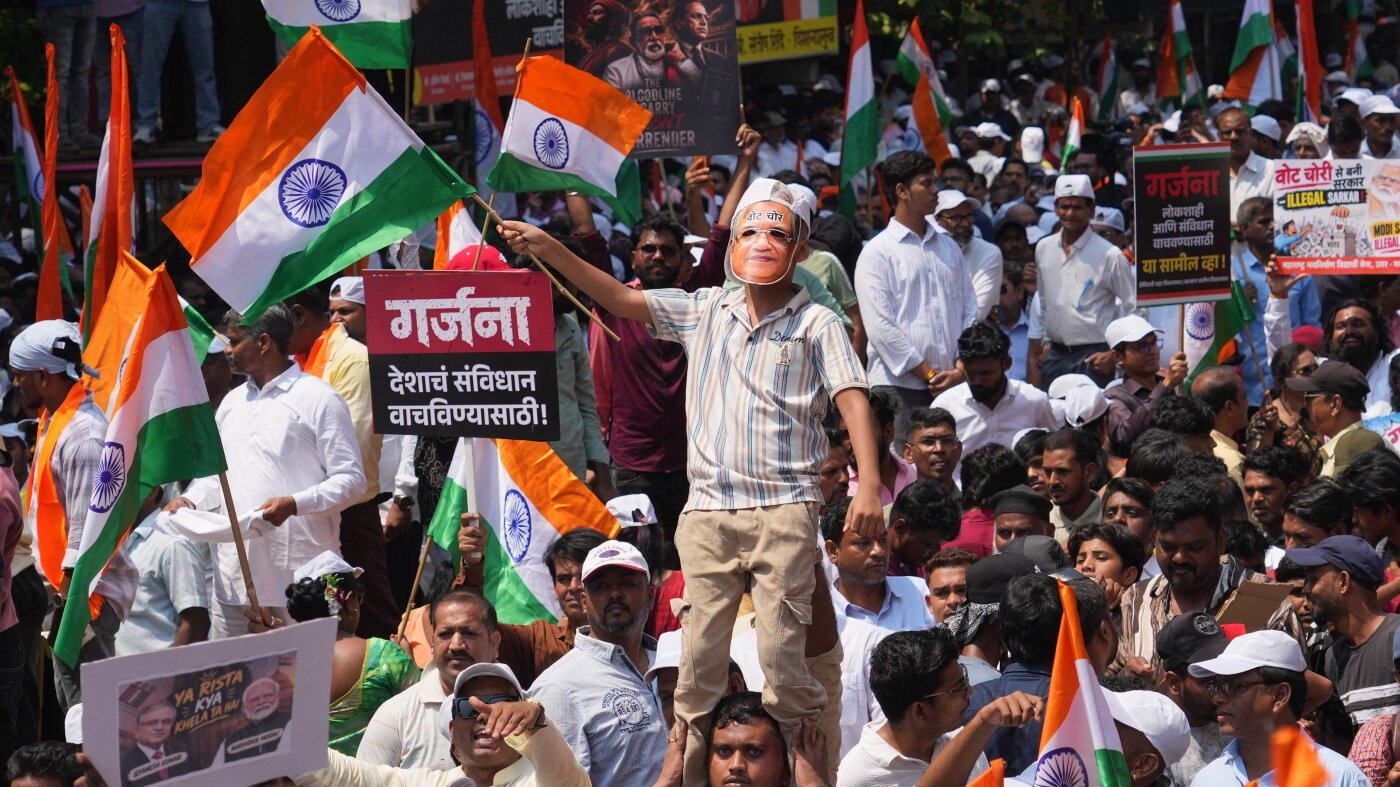
In 2023 and 2024, the BJP faced nationwide protests triggered by opposition remarks regarding Prime Minister Modi. Opposition leaders, including members of the Congress and regional parties, made allegations of "Modi Adani" scams and questioned the government's handling of communal violence.
### Public Reactions and Media Narratives
Advertisement
Loading partner content...
The protests, while drawing large crowds in states like Uttar Pradesh and Delhi, were largely viewed by the BJP’s massive voter base as a nuisance. The media narrative often framed these as "anti-India" or "urban naxal" elements, a narrative promoted by pro-BJP media houses.
---
## Opposition Strategies & Counter-Narratives
The main opposition, the <b>Indian National Congress</b>, has struggled to mount a cohesive challenge against the BJP's organizational strength.
### Coalition-Building Efforts
Advertisement
Loading partner content...
The opposition has attempted to form opposition alliances, such as the "INDIA" bloc in 2024, which was seen as a united front against the BJP. However, internal differences and lack of a strong leader have hampered its effectiveness.
### Rhetoric Against the BJP
Opposition parties frequently use the language of "Hindu terrorism" and "minority appeasement" to counter BJP narratives. However, these counter-narratives often struggle to break through the BJP's media dominance.
---
## Future Outlook
Advertisement
Loading partner content...
As of 2026, the BJP is preparing for the upcoming state and national elections. Internal challenges include the dominance of the OBC and Dalit vote bank, which was previously ignored but is now being targeted by the BJP.
### Potential Trajectories
- <b>Electoral Success:</b> The BJP is expected to continue its winning streak in the 2024 elections, though the opposition may perform better in the South.
- <b>Internal Party Challenges:</b> The rise of regional leaders within the party could lead to factionalism.
- <b>Coalition Possibilities:</b> The BJP may need to rely on coalition partners like the TDP and JD(U) in the South.
---
## Global Perspective
Advertisement
Loading partner content...
The BJP's rise mirrors the global rise of right-wing nationalism. Movements like the Republican Party in the US and the National Rally in France share similarities in their cultural nationalism and anti-establishment rhetoric.
### Commonalities and Differences
- <b>Commonalities:</b> Use of Hindu nationalism, strong central leadership, and appeals to national pride.
- <b>Differences:</b> The BJP's focus on economic development and welfare schemes contrasts with the more culturally conservative agendas of Western counterparts.
---
## Conclusion
Advertisement
Loading partner content...
The <b>Bharatiya Janata Party</b> has come a long way from its humble origins to becoming the central pillar of Indian politics. Its ideology of <b>Hindutva</b>, combined with economic pragmatism, has reshaped the Indian political landscape. While the party faces challenges in balancing cultural nationalism with social justice, its influence on Indian democracy remains unparalleled.
As the BJP continues to lead India into a new era, its impact on the country's secular fabric, economic policies, and global standing will be studied for decades to come.
---
## Metadata
Advertisement
Loading partner content...
---
<figure class="my-8 overflow-hidden rounded-3xl shadow-xl">
<img src="https://www.aljazeera.com/wp-content/uploads/2026/10/AFP<b>20261011</b>D2WC8EY<b>v1</b>HighRes__IndiaPoliticsProtest-1791785951.jpg?resize=1920%2C1440" alt="BJP Rally" class="w-full h-[400px] object-cover" />
</figure>
<figure class="my-8 overflow-hidden rounded-3xl shadow-xl">
<img src="https://images.pexels.com/photos/2573473/pexels-photo-2573473.jpeg?auto=compress&cs=tinysrgb&dpr=2&h=650&w=940" alt="Indian Parliament" class="w-full h-[400px] object-cover" />
</figure></i></i>